Wednesday, April 5, 2017

Brief Description of Bhakti Yoga.


The Hare Krishna Maha-Mantra

Hare Krishna, Hare Krishna
Krishna Krishna, Hare Hare
Hare Rama, Hare Rama
Rama Rama, Hare Hare.

No one lives forever

Every living creature is subjected to four basic miseries, beginning with birth, continuing into old age and disease, and ending in death. No one wants to be miserable—everyone wants to be happy—but material nature functions in such a way that no one can be happy.
Ignoring this basic truth, modern thinkers, politicians, scientists, educators and artists are all struggling against the stringent laws of nature. They think that by material adjustments they will find the happiness they hanker for. In spite of all comforts and the advancement of science, economics and politics, no one is happy—if for no other reason than life is temporary.

Time and energy dedicated to God

The Hare Krishna movement offers a program to get out of the material world altogether. We accept the statements of the scriptures that beyond this temporary manifestation of material creation there is another permanent creation. In this temporary life, a human being should do everything possible to promote himself to that permanent life, which is eternal, spiritual life. This is man’s only duty in life. Science, medicine, education, art, music and poetry should all be applied for achieving this end, rather than for improving an illusory life of material enjoyment, which may be immediately pleasing, but is only temporary.

Living by the laws of God

The highest authority is God Himself. God speaks through shastras, or scriptures.  There are a number of authorized scriptures in the world in different communities, but the principles of all scriptural injunctions are the same. According to time, place and circumstance, there may be different scriptures, different languages and different customs, but the principles of religion are the same. The teacher may be different, the school may be different, the language may be different and the teaching technique may be different, but the conclusion is the same.

Hare Krishna Movement is genuine and authorized, not a newly invented religion or cult

Krishna consciousness is a science. Religion is not a sentiment meant for a section of the population to believe. Religion is based on the authority of shastras, or scriptures, and the conclusions of the shastras are perfect. The Hare Krishna movement is based on the teachings of Bhagavad-gita and Srimad-Bhagavatam, which are Vedic literatures written more than 5,000 years ago. This movement has come down through the line of disciplic succession, or the line of spiritual masters, beginning with Krishna and continuing down to the present day.

What is the Hare Krishna program for self-realization?


Sri Krishna Chaitanya Mahaprabhu
Five hundred years ago, Krishna appeared again as Lord Chaitanya. The Srimad-Bhagavatam and other Vedic literatures predicted that Lord Chaitanya would be the Yuga Avatar, or the incarnation of Godhead for Kali-yuga, the age of darkness, quarrel, hypocrisy and dissension. Lord Chaitanya especially stressed the process of sankirtan, or congregational chanting of the holy names of the Lord. Although there are many paths of spiritual realization, and the body of Vedic literatures is vast, Lord Chaitanya taught that in this age the general mass of people would not be able to practice these various paths of spiritual discipline. Therefore He recommended that people in this age should practice chanting the holy names: Hare Krishna, Hare Krishna, Krishna Krishna, Hare Hare/ Hare Rama, Hare Rama, Rama Rama, Hare Hare. This movement is primarily spreading the teachings of Bhagavad-gita and Srimad-Bhagavatam and the chanting of the holy names.

Tuesday, April 4, 2017

Rama Navami, the Appearance Day of Lord Rama


Sri Srimad Bhaktivedanta Narayana Gosvami Maharaja

GLORIFICATION OF SRI SITA-RAMA
Mathura, April 13, 2000

[This year, 2017, April 4 is the appearance day of Lord Rama. In honor of this day, we are sending out Srila Narayana Gosvami Maharaja’s lecture in glorification of Sri Sri Sita-Rama:]

Listen 
After Ravana was killed, Sita devi had to undergo the agni pariksa, fire test. Of course, Maya-Sita entered the fire, and the real Sita devi remained unharmed – proving that she was completely pure and chaste. Rama then gave the kingdom of Ravana to Vivisana, Ravana's brother, and after that he took Sita devi and all their associates to Ayodhya on a mystic airplane. There were millions and billions of associates, but this airplane was able to expand so that they could all fit on it.

On their journey, Rama pointed out to Sita all the places where they had enjoyed pastimes together, or where He and Laksmana had killed various demons. For example, Rama would say, "Oh look, here is where we built the bridge to Lanka. Do you remember?" When they reached Kishkinda, where all of Rama's monkey associates lived, they stopped. Sita devi then invited all the wives of the monkeys to come aboard the airplane, as they were also very interested to see Rama's coronation.

The party stayed one night and then went to Citrakut. Hanuman took the form of a brahmana and went to the place where Bharata was staying in Nandigram. Bharata was living the life of a renunciate, wearing simple cloth, with matted hair and living on fruits and roots; and all of his ministers lived in the same way. In the guise of a brahmana, Hanuman approached Bharata and said, "Oh Bharata Maharaja, Rama has come. Prepare to welcome him!" Upon hearing that his dear brother had finally returned, he was overjoyed and fainted. When he came to consciousness he said, "I want to give you many gifts. So please accept 18,000 cows, as many beautiful women as you desire, horses and other wealth. Still I cannot give you anything equal in value to the news you have given me." Hanuman then returned to his original form, and Bharata said, "Oh, you are Hanuman!"

After Rama’s abhiseka ceremony, he wanted to give many gifts to everyone. Sita devi thought of a very nice gift to give Hanuman, so she gave him her most beautiful pearl necklace. Hanuman took it, examined it and broke it, and the pearls scattered all over the floor. Sita devi was surprised and asked, "What are you doing?" Hanuman replied, "Oh, I was just seeing if 'Rama' is written anywhere here." "But don't you know Rama is in your heart?" she said. Then Hanuman tore open his chest. In this way, Rama’s associates teach us that whatever is given to others should be in connection with Krsna.

Lord Rama and Sita devi stayed together for many years, and everyone was very happy within their kingdom. Some people, however, criticized Rama for accepting Sita back after she had been in the palace of Ravana. According to Vedic principles, it is unacceptable to accept one's wife after her being away for one night – what to speak of one year. One evening, the wife of a washer-man came home late. Her husband immediately told her that she could not enter the house. He threw her out saying, "I am not like Rama, who accepted his wife back after she'd been with another man."

This news spread and the story got back to Rama. He was most disturbed, and realized that he had to do something. How could he rule a kingdom in which some of the people did not have faith in him? He called a meeting, asking all his brothers to come; but none of them could give him any advice. He himself then realized what to do. He remembered that Sita had desired to visit all the sages in the forest and shower them with gifts. He asked Laksmana to take her to the asrama of those sages, deliver his sorrowful message to her, and then leave her in the forest. Laksmana was devastated that he was called upon to do this, but he could not say anything, as he was Rama's younger brother. He therefore had to accept that responsibility.

Sumanta was Laksmana's chariot driver, and moreover a very great minister of Rama. Laksmana told everything about Rama's order to Sumanta and said, "My life is full of miseries. Now, today is the biggest misery of my life!" They passed Prayag and went across a river. "Valmiki's asrama is here," Laksmana told Sita. Then, with a heavy heart he told her, "Everyone is accusing Rama of accepting an unchaste wife. Many people don't have full faith in him now; so how is it possible for him to rule the kingdom and guide the citizens properly?"

When Sita devi heard this she fainted, and when she revived she said, "I don't want to create any difficulties for him. I do not want him to be disturbed by the public. Please pay my obeisances to all. Laksmana, I want to pray at your lotus feet, as I have offended you twice. The first night in Ayodhya, after our marriage ceremony, I stopped you from massaging Rama's lotus feet. Though this had been your cherished duty for many years, I took this away from you. When you asked Rama about this, he could not answer. Then we asked the great sage Vasistha and he said, 'The duties now have to be divided. So Laksmana, all the duties outside of the house should be taken by you. Sita devi should now perform all the duties inside of the house.' In this way it was decided.

"Secondly, I was once allured by a deer in the forest when we were in exile. I heard Marici call out, 'Alas, Laksmana!' Assuming it was Rama's voice, I told you to go immediately to help Him. You said, 'No Sita, it is an illusion created by a demon.' I insisted and told you, 'I know. You are a spy of Bharata, and you have lusty feelings for me. That is why you don't want to save your brother!' These words pierced your heart. You replied that you always saw me as your mother and had never even seen my face; you had only seen my feet. You could not bear these harsh words. Then, when you went to see Rama, he chastised you saying, 'Why did you take heed of the words of that woman?' Then Ravana came here and begged, 'biksana dehi' three times. When I did not want to come outside of your circle of protection he threatened me, 'I curse you that your husband will die if you do not give anything to me here!' So please forgive me for these offenses."

After leaving Sita devi in the forest Laksmana lamented, "Oh, alas! I will surely give up my life!" Sumanta tried to pacify him, and told him the truth of the matter. "Once I was with Dasaratha Maharaja, and at that time two sages, Vasistha Rsi and Durvasa Muni, came to visit him. Maharaja Dasaratha served them very nicely and then asked them to kindly tell him about the future of his four children. Vasistha Rsi remained silent and Durvasa Muni responded by saying, ‘Oh, you have four sons. Very good." Dasaratha Maharaja said, "Yes, first tell me about Rama's future." Durvasa said, "Rama's future will undoubtedly be full of miseries. He will have to leave Ayodhya, and everyone there will feel unbearable separation from Him. You will not be able to bear His absence, and you will die in separation. Rama will later have to be separated from his wife, and after suffering immensely they will become reunited. Then again they will have to be apart; and Rama will rule the kingdom alone without his wife. Do not tell this to anyone." Dasaratha Maharaja was in complete shock, but he promised that he would not speak what he had heard to anyone. He said, "From today, I am your disciple."

Having heard this from Sumanta, Laksmana realized that his brother Rama is in fact the Supreme Lord Visnu. Sumanta continued telling Laksmana the story that Durvasa Muni had told to Dasaratha Maharaja: "Once, a very big battle ensued between the demigods and the demons. The demons were defeated and went to the wife of Brghu Maharaja to take shelter; and, being very merciful, she gave them shelter. The demigods went to Lord Vamanadeva and told him the situation. He then took His cakra and beheaded Brghu Maharaja's wife. Brghu Maharaja was very upset and cursed Vamanadeva saying, "You are responsible for my wife's death. I loved her very much. Now I will have to suffer so much in separation from her. For this I curse you that you will have to suffer in the same way in the future. You will have a very beautiful wife who will serve you in every way. You will be fully satisfied and completely enamored with her feminine grace and charm, and her saintly qualities. You will then be separated from her, and you will always suffer immensely from that pain of separation." Hearing this, Vamanadeva happily accepted the curse. He knew that in the future the whole world would be benefited by this. Also, this was but a pretext, as separation naturally increases the happiness of meeting.

Sita devi was walking towards the asrama of Valmiki Rsi, when some of his brahmacaris spotted her. They informed Valmiki that a lady looking like a demigoddess was coming. Valmiki came out to greet her, and immediately recognized who she was. He said, "Oh, you are Sita devi, the wife of Lord Rama. I know this because I have written the Ramayana. Please come in." The ladies there were very pleased to see Sita devi and said, "Oh, please allow us to serve you." Valmiki instructed them how to serve her in every way.

When Rama sent Satrughna to Mathura, he happened to come near to Valmiki's asrama on the way. He paid obeisance to Sita devi and her sons, Luv and Kush, from a distance. Luv and Kush were very intelligent children. Valmiki was very expert in archery, singing and music, and he taught Luv and Kush these arts. They could thus sing in all ragas very sweetly. Valmiki also taught them the Ramayana.

No one in the entire kingdom was there to console Rama. However, the ladies were there to console Sita devi in the asrama of Valmiki. One day Rama turned to Vasistha Rsi and said, "Will you please perform a sacrifice?" Vasistha replied, "Then you must call your wife back." "Oh, I cannot do that." "Then you must remarry," he insisted. Rama said, "It is not possible." "Then you will have to make a golden deity of Sita devi." Vasistha then performed the sacrifice. In fact, every year he performed a very big sacrificial ceremony for Rama, near Naimisaranya on the bank of Gomati, with a new golden deity of Sita devi each year.

One year many kings and sages were called, and Valmiki came with Luv and Kush. The boys were extremely beautiful, with very broad chests and slender waists. During a rest period, Valmiki asked them to sing Ramayana. They had melodious voices, and they sang in such a heart-rendering way that they captured everyone's hearts. Rama was especially touched, and tears came to His eyes. Valmiki had previously warned the boys, “If anyone asks you who you are, tell them, 'I am a disciple of Valmiki'”. Rama ordered Laksmana, "Go and give them eighteen thousand gold coins and many, many beautiful clothes and gifts. Then ask them who they are."

When they were presented with these gold coins, clothes, and gifts, they said, "What will we do with all these things? We are brahmacaris." Then Laksmana asked which dynasty they belonged to, and they replied, "You seem very learned. Why ask this? Why not ask who is our Gurudeva? We are disciples of Valmiki Rsi." For five or seven days they came and recited the Ramayana, and after many days Rama and others came to know who they were.

Rama then called Valmiki and requested that Sita devi come and prove Her chastity so that he could call her back. Valmiki said, "I have never spoken a lie in my life. I can assure you that Sita is completely pure and chaste." Rama said, "I know that. I'm quite confident of this, but I want proof for my citizens. So please bring Her here. Then we'll see what we can do."

At this time Brahma, Sankara, and many demigods and goddesses came, curious to see this event. Sita devi sent Luv and Kusa ahead to their father. She arrived thereafter, and Valmiki spoke gently to her, "O daughter, Sita devi. Come forward and prove your chastity." Sita devi said, "Mother, please prove this to one and all, that I have never served any other man. I have never even had thoughts of any man other than Rama in my whole life. Please accept me, mother." Pritivi-devi appeared from the earth and Sita sat on her lap on a golden throne. In a moment, Prthivi-devi completely covered Her. In other words, she took Sita devi with her, back under the Earth. Rama couldn't bear to see Sita leave him like this, and he fainted. Then, when he returned to consciousness, he prayed to Prthivi-devi, requesting her to bring back Sita. He told her, "One time I went with a bow to the ocean and he was very much afraid. So I can turn you into dust in a moment." Just then Brahma came and told Rama, "No. Don't do it! This is the last time. Sitaji has gone to your own abode, so you should very quickly wind up your pastimes and go there."

Gaura premanande!

Wednesday, March 29, 2017

The Glories of Ramanujacarya

(From Harikatha newsletter)
This year, 2017, Sri Ramanujacarya’s appearance day is April 1 (in America). In order to serve you in observing this sacred day, we are sending you a transcription of Srila Narayana Gosvami Maharaja’s informal darsana, given in North Shore, Hawaii, on January 26, 2007. That informal darsana took place with only the devotees in his traveling party, so we especially thank his personal cook, Madhuvrata dasa brahmacari, for sending us the sound-file. Srila Narayana Gosvami Maharaja’s talk in Hawaii was brief, and therefore we have included excerpts from his lecture given in Mathura, in 2000, in brackets, to fill out the history:]

Sri Ramanujacarya was born in South India. He is an incarnation of Laksmana. The word ‘anuja’ means ‘younger brother’. Rama-anuja refers to the younger brother of Lord Rama; therefore, he is Ramanuja. In Kali-yuga, he is the acarya of the Sri (Laksmi) Sampradaya. He is the disciple of Yamunacarya.

As a boy, he was exceptionally intelligent. At a very young age, he knew all Sanskrit grammar (vyakarana), literature (sahitya), and all the deep conclusions of the Vedic scriptures.

[Sri Ramanujacarya is an incarnation of Laksmana (Lord Rama’s younger brother), and he accepted the Sri Sampradaya. Srila Bhaktisiddhanta Sarasvati Thakura Prabhupada took many teachings from him, such as the duties of the sannyasi, the duties of the disciple, and the etiquette of the Vaisnava. He utilized one-hundred eight teachings. We follow these teachings, and we have also published them in our Bhagavata Patrika and Gaudiya Patrika (Hindi and Bengali Magazines).]

His teacher, Yadavacarya, was a follower of the Mayavada (the theory that all variety and individuality are illusion) and Advaitavada (the theory that the only truth is impersonal undifferentiated oneness) philosophies. One day, his teacher began to explain his understanding of the beauty of Sri Krsna’s eyes. In this regard Chandogya Upanisad uses the word ‘kapyasam.’ Yadavacarya explained that ‘kapi’ means ‘monkey’, and that the monkey’s rear-end (kapi-asam) is reddish on both sides. He concluded that Krsna’s lotus eyes are like a monkey’s rear-end. Hearing this, Ramanuja began to weep.

Later, when Ramanuja was massaging Yadavacarya, he told him, “The explanation you have given for kapyasam is wrong. ‘Kapi’ can be understood to mean ‘that which takes water from everywhere’. Who takes water? The sun. The word ‘asam’ also means ‘to blossom’, so the word ‘kapi-asam’ can be understood as ‘that which blossoms under the sun,’ or, in other words, ‘the lotus flower’. Thus, we can understand the verse to mean that the Lord’s eyes are as beautiful as the lotus flower.”

[Sri Ramanujacarya took birth in a simple family. His mother and father were not very wealthy, but they were of a high brahmana caste and they were very learned. Ramanuja was an outstanding boy from his childhood. While under the guidance of a Mayavadi guru named Yadavacarya, he was very careful in his studies. One day, when his guru was giving an impersonal explanation of a verse that contained the word kapyasana, he compared the lotus-eyes of the Lord to the hind part of a monkey which is reddish near its tail. Hearing this from his Gurudeva’s mouth, Ramanuja began to cry in great pain. He felt grief in his heart that his Gurudeva had used such a bad analogy for describing the lotus-like eyes of the Lord. After collecting himself, he very politely asked if he could say something about the verse. Yadavacarya assented, and Ramanuja very nicely gave many explanations according to Sanskrit grammar. He said that the term kapyasana actually means one who brings water, and that is the sun. The lotus blossoms by the potency of the sun, and therefore the Lord’s eyes are compared to the lotus, not the monkey.]

Ramanuja’s teacher became astonished, thinking, “If this boy is so knowledgeable at such a young age, what will he do when he is grown up? If he remains alive, this Mayavada teaching will be finished.” His teacher then planned to murder him.

[When Yadavacarya heard this, he thought, “This boy is dangerous. He is very expert and is giving such nice explanations. In the future he might uproot all the impersonal teachings from the Vedas, and so I must kill him.”]
Thinking to trick Ramanuja, Yadavacarya told him that he was going to travel with all his students to do some preaching, and that Ramanuja should also accompany them. Ramanuja was a very sincere and innocent boy, so he didn’t understand his teacher’s intentions.

Then, when they were all in a very deep forest, they decided that this would be the time to murder him. Govinda, his cousin-brother, told him of their plan, and urged him to quickly flee from there. Therefore, in the middle of the night, Ramanuja told them that he was going to the toilet, and he ran away.

Now alone, he suddenly saw a hunter, along with his wife, holding a hurricane light. The man asked him, “Where are you going?”

Ramanuja answered, “I am going to Kancipuram.”

The man replied, “We are also going there, so come with us.”

When he arrived at Kancipuram, his own village, which was very far away, those persons disappeared. Ramanuja then began to weep. He understood that it was certainly the Supreme Personality of Godhead, Narayana Himself, along with His eternal consort, Laksimi-devi, who had saved his life.

[Throughout the day and night, he passed through the dense forest. It was difficult for him to discern his way, especially at night. The Lord, seeing His dear devotee in such a state, then appeared in the form of Bharadraja and, holding a lantern in His hand, showed Ramanuja the way. Thus, within no time at all, Sri Ramanuja crossed the entire distance of the forest and found that he was standing outside his village.]

Sometime later, Ramanuja’s teacher returned to the village. He had been thinking that perhaps a lion or tiger had eaten Ramanuja, and he was very happy. However, when he arrived, he saw that Ramanuja was alive. He called him and told him to forget everything that had happened, Ramanuja again resumed his Sanskrit studies with Yadavacarya.

[After some days, out of compassion for Yadavacarya and with a desire to deliver him, he again began studying under his guidance. After some years, Ramanuja converted Yadavacarya to Vaisnava philosophy, whereupon his teacher became his disciple. At one point thereafter, Ramanuja began hearing of the qualities of a great Vaisnava guru in South India by the name of Sri Yamunacarya, and he eventually became Sri Yamunacarya’s disciple.]
Later he married. After his marriage, he began to teach boys in a Sanskrit school, and all the students liked him.

[Later on he married, and his wife was very quarrelsome. Her behavior was discourteous and uncooperative, and incidents would often take place which he would somehow have to tolerate.]

One day, a disciple of Sri Yamunacarya named Kancipurna came to the house of Ramanuja. He was from a very low-caste family, but he was a very high-class devotee. He came there along with his wife by the order of his Gurudeva, and he now began to give his association to Ramanujacarya.

[A disciple of Sri Yamunacarya and elder god-brother of Ramanuja named Kancipurna came to Ramanuja’s village along with his wife. Ramanuja accepted Kancipurna as a siksa-guru.]

One day, when Ramanujacarya’s wife was drawing water from the well, Kancipurna’s wife was also there drawing water. Some water from the bucket of Kancipurna’s wife fell into Ramanuja’s wife’s bucket. She immediately became very angry and started to insult the wife of Kancipurna with abusive language. When Kancipurna returned, his wife told him of the incident at the well, and he immediately left the house of Ramanujacarya. Upon hearing the reason why his siska-guru had departed, Ramanujacarya began to think, “I should not be with this lady. Somehow, I should give her up right away.”

[One day, when Kancipurna’s wife was taking some water from a well, she met Ramanuja’s wife, who had also come to the well for drawing water. It so happened that while taking the water out of the well, some water from the pot of Kancipurna’s wife spilled into the pot of Ramanuja’s wife. Although this was a small accident, Ramanuja’s wife became furious and insulted Kancipurna’s wife with abusive language. Kancipurna became hurt when he later on heard about this, and, without informing Ramanuja, he and his wife left that place and went to Sri Rangam. When Sri Ramanuja came to know that his wife’s behavior had offended a Vaisnava, he felt very bad and thought, “She is committing vaisnava-aparadha; she has such an offensive mentality. I must do something about this.”]

Later, Sri Yamunacarya sent Purnacarya to bring Ramanuja to him in Sri Rangam. However, Yamunacarya was very sick at that time, and, by the time Ramanuja arrived in Sri Rangam, he had departed from the vision of the world. Purnacarya, was sent there to bring him to Sri Rangam. Ramanuja used to give him so much honor – always offering him obeisances and treating him like his siksa-guru. While living with Ramanuja, Purnacarya began to impart the instructions he had received from his Gurudeva, Sri Yamunacarya.

One day, when Ramanuja was teaching at the school, a hungry brahmana came there. Ramanuja told him, “If you go to my house to beg, my wife will give you something.” However, when the brahmana went there, Ramanuja’s very cruel wife said, “I can’t give you anything. Go! Get out of here!” The brahmana returned to Ramanuja, who then told him to go back to his house and tell my wife, “I am coming from the house of your father. He sent me to you, so please take this letter from him.” Ramanuja personally wrote the letter he gave to the brahmana to deliver to his wife. The letter stated, “Your brother will marry very soon, so you must come to your father’s house.” After reading the letter, Ramanuja’s wife began to honor that brahmana, and she gave him a large quantity of delicious prasadam.

[One day, a hungry brahmana came to Ramanuja, asking for some food. Ramanuja sent this brahmana to his wife, telling him, “Go to my home and tell my wife that I sent you. She will give you some food.” When that brahmana came to Ramanuja’s wife, she boldly insulted him again and again. She told him he should get out of there, and that there was no food for him. Returning to Ramanuja, the brahmana reported what had happened, and Ramanuja replied, “Wait here for a few minutes.” He left and wrote a letter to his wife, as though it was written by her father, stating, “O my dear daughter, I am arranging the marriage of my son, your brother. So you should come. Please bring your husband with you.”

Writing these words very nicely, he folded that letter and tied it with colorful threads. And, along with that, he sent a coconut and other auspicious items. He then gave that letter to the brahmana and said, “Now go again to my wife. She will welcome you nicely this time. The brahmana went again. After reading the letter, Ramanuja’s wife’s behavior completely changed. This time she welcomed him warmly and sweetly, and offered him all kinds of palatable food and sweets. When Ramanuja came home, his wife told him about the marriage. She cited her father’s request for both of them to come, and requested him to please come along.

Ramanuja said, “No, I cannot come, for I am very busy; you may go now with this brahmana. Don’t be late.”]
When his wife left to go to the house of her father, Ramanuja also left that house. He went to Sri Rangam to meet his Gurudeva, Sri Yamunacarya, but

Yamunacarya had left his body just before Ramanuja arrived. Ramanuja saw that many devotees were walking with the transcendental body of Yamunacarya. All of his disciples were weeping as they carried his body to be placed in samadhi.

[After his wife left with that brahmana, Ramanuja locked the door of his house and went to Sri Rangam to meet his Gurudeva, Sri Yamunacarya. He wanted to take sannyasa from him, but when he reached Sri Rangam, he found that Sri Yamunacarya had just passed away and his disciples were walking in procession with his divine body. Ramanuja felt very disheartened and sad.]

He told them, “I have accepted Yamunacarya as my Gurudeva. I want to see his face.” Yamunacarya’s disciples stopped and lifted the cloth from his body. Ramanuja could see that three of Yamunacarya’s fingers were folded.

[He asked them to stop for a moment. He wanted them to uncover the transcendental body so that he could take darsana of his Gurudeva’s divine form. He observed that all the fingers on one of his Gurudeva’s hands were open, and on the other, three fingers were closed. He inquired from the disciples all around as to why this was, and he wanted to know when it happened. No one could answer. They said, “We didn’t notice it before; it must have happened just now.”]

He promised in front of all present, ‘I will write the Sri-bhasya commentary on the Vedanta-sutra.” One of the fingers immediately became straight. He then said, “I will take sannyasa,” and the second finger relaxed. Lastly, he said, “I will preach the mission of my Gurudeva, Yamunacarya”, at which time the last finger relaxed and became straight. Seeing this, everyone present became astonished.

[Ramanuja became silent, and after some time he spoke, addressing Sri Yamunacarya’s transcendental body. He said, “Now, I will first of all write a Vaisnava commentary on Vedanta, and I will preach that Vaisnava commentary throughout India.” One finger opened, and Ramanuja spoke further, “I will take tridandi-sannyasa right now, and I will preach the message of vaisnava-dharma and your teachings.” When Sri Yamunacarya heard that, his second finger opened. Ramanuja then said, “I will systematically write about Vaisnava etiquette, explaining the behavior required to execute pure devotional service, and what precautions should be taken. I will also preach this throughout India.” After uttering this third statement, Sri Ramanujacarya observed, along with all present, that three of Yamunacarya’s fingers had now opened. Then and there, Sri Ramanujacarya formally accepted tridandi sannyasa from Sri Yamunacarya.]

After Yamunacarya was given samadhi, Ramanujacarya was elected to become the next acarya, as Yamunacarya’s successor. He immediately said, “I will not become the next acarya right away. Give me time. Give me two years.” He then spent some time with each of the prominent disciples of Yamunacarya. He served them and heard from them what they had learned from their Gurudeva. Only after hearing from them for two years did he accept the post of acarya.

[Sri Ramanujacarya had now formally taken sannyasa initiation from Sri Yamunacarya. Afterwards, all the disciples of Sri Yamunacarya, who were great scholars and who had served their Gurudeva for so many years, came together. Having seen the extraordinary characteristics and personality of Sri Ramanujacarya, they collectively decided that he should be appointed as the next acarya after their Guru, and they honored him with the acarya seat in Sri Rangam. Sri Ramanujacarya accepted the orders of his god-brothers, but before sitting and acting as the acarya, he went to each of his god-brothers, for two months, four months, six months, or one year, and served each of them. He thus formally endeavored to understand the teachings of Sri Yamunacarya, since he had not gotten the opportunity to spend much time with him. After serving and satisfying them, he commenced his role as acarya of the Sri Sampradaya in Sri Rangam.]

Later, the ruler of that country, King Koluttunga II, heard that Ramanujacarya was very strongly preaching his philosophy. Koluttunga II wanted him killed, fearing that if he remained alive, the Saiva Sampradaya (comprised of so-called devotees of Lord Siva) would be finished. He sent a message telling Ramanujacarya to come at once for a debate.

Ramanujacarya and all his associates knew that the king wanted to kill him. His disciple Kuresh told him, “Gurudeva, please do not go. I will go in your place. Please give me your danda and sannyasa cloth.” Insisting, Kuresh took them from him and gave him his own white cloth. He told Ramanuja to leave that place at once. Then, having taken his Guru’s sannyasa cloth and danda, Kuresh went to the palace of the king.

In the palace there was a great debate, during which Kuresh defeated all the king’s pandits. However, Kuresh was alone, so the king’s pandits told everyone that he had been defeated. They forcibly detained him, and only released him after blinding him by plucking out both of his eyes. He then began to search for his Gurudeva, who was now very far away. Fortunately, after some time, he came to the same village where Ramanujacarya was residing.

Within that village there were two disciples – one very rich and one very poor. Ramanujacarya told his disciples to go to the house of the rich devotee, because his group was more than fifty in total, and ask him to prepare prasadam and a place to stay for all of them.

Two of Ramanuja’s disciples went to the rich man’s house and gave him this message. The rich man felt extremely happy and became totally absorbed in preparing for the arrival of Ramanujacarya and all of his devotees. However, he didn’t come back out to share these plans with his two god-brothers at the door. After waiting for some time, those disciples went back to Ramanujacarya and told him that they had gone to the house of that rich devotee, but he had left them waiting and had not come back to them. Ramanujacarya replied, “Oh, then we will all go to the house of that poor man.”

That very poor brahmana used to go and beg for ingredients so that his wife could cook prasadam. He had only one piece of proper cloth, which his wife used, so when he would go begging, he would take the cloth of his wife.

On that particular day, after midday, he could not collect any more, and he decided to return home. In the meantime, before his return, Sri Ramanujacarya, with all of his disciples, suddenly came to his house. His wife was very happy to see her Gurudeva, but she also felt very ashamed because she had no proper cloth to wear. Sri Ramanuja understood this, and he gave her his own chadar. She wrapped this around herself and came in his presence.

After she gave a mat for her Gurudeva and his followers to sit on, she began to wonder, “How shall I arrange prasadam for everyone?” She remembered that one of her neighbors, who was a rich businessman, was very attracted to her and had lusty desires toward her. He had previously told her of his desires, but she was very chaste and had always rejected his proposals. However, in her current predicament, she went to that man and told him that she would fulfill his desire.

She was thinking, “What is the use of my chastity if I cannot serve my Gurudeva? For my Gurudeva, I should be prepared to do anything.” She told that rich man, “I am ready to do what you want, but in return I want you to arrange many ingredients so that I can cook and give prasadam to my Gurudeva and all of his disciples.” Hearing this, the rich man became very joyful and gave her more than what she wanted. Taking all that he gave her, she prepared very good prasadam for all the devotees, and everyone was happy.

While Ramanujacarya and all the devotees were resting after prasadam, her husband returned home. He asked her, “Gurudeva and all his disciples have come. How are we going to arrange for their needs?”

She replied, “I have done everything. There is nothing to worry about. They have all taken prasadam and are resting now.”

Her husband asked, “How did you make all those arrangements?”

She began to tell him the story about the lusty neighbor. She said, “I was thinking that my Gurudeva has come; if I cannot serve him, then what is the use of my chastity? So I went and told that lusty man that if he would give me all the ingredients to make very nice prasadam, then I would offer myself. He did as I asked, so now that it is night I must go to him.”

Her husband told her, “I will come with you.”

It was raining at that time, so they took an umbrella and went to the house of that rich person along with the mahaprasadam. The wife entered his home alone, and the man became very happy. The man asked her, “It is raining heavily tonight, and it appears you have come all alone. Didn’t anyone bring you?” She told him, “My husband came with me,” and she gave him the prasadam remnants of Ramanujacarya. The lusty man took those remnants and became totally transformed. He fell flat at the lotus feet of that lady and begged her, “Excuse me. Excuse me.”

The lady and her husband then returned to their house. The next day, their neighbor came to Ramanujacarya and prayed to him, “I want to be initiated by you.” Ramanujacarya then initiated him.

In the meantime, Kuresh arrived in the village of the poor devotee couple where Ramanujacarya was staying. Seeing Kuresh, Ramanujacarya called out his name. Kuresh went to his Gurudeva and wanted to take his darsana, but he had no eyes. Ramanujacarya put his hand over Kuresh’s wounds and two eyes at once manifested. He could see again.

Afterward, Ramanujacarya went to North India. After traveling for a long time, he eventually arrived in Kashmir. He went to Sarada-pith, the place of Sarada-devi, where he came across the Bodhayana-bhasya (commentary) of Vedanta-sutra. This Bodhayana commentary contained Vaisnava philosophical conclusions, not Mayavada theories. In the library at Sarada-pith he read that commentary, and in the night he took that book and escaped with Kuresh

They fled from there, but the Kashmiri pandits followed them. Finally, the pandits took the book and returned to their own place. Ramanujacarya was very unhappy, but Kuresh told him, “Gurudeva, do not be unhappy. I have also read that book, and I remember all its contents. I will write them down.” Later he did this, and he gave the writings to Ramanujacarya. Ramanujacarya then wrote his Sri-bhasya on Vedanta-sutra [*See Endnote] and fulfilled the three desires of his Gurudeva, Yamunacarya.

[When Sri Ramanujacarya officially became the acarya, he began very strongly preaching the cult of Sri Yamunacarya. In South India, two impersonalist sects are very prominent: Saiva and Sankaracarya. Sankaracarya’s followers subscribe to the Vedanta sutras like "sarvam kalvidam brahma" and "tat tvam asi." They think themselves impersonal brahma (God), and they think everything comes from brahma. The Saiva School considers Lord Siva to be the ultimate truth, and they want to merge into him. This is the basic difference between the two. Sri Ramanujacarya refuted and defeated all impersonalism by his very strong and effective preaching.]

Gaura premanande

[*Endnote: Sri Ramanujacarya has also refuted the arguments of Sankara in his own commentary on the Vedanta-sutra, which is known as the Sri-bhasya: "Sri Sankaracarya has tried to equate the Pancaratras with the philosophy of the atheist Kapila, and thus he has tried to prove that the Pancaratras contradict the Vedic injunctions. The Pancaratras state that the personality of jiva called Sankarsana has emerged from Vasudeva, the supreme cause of all causes, that Pradyumna, the mind, has come from Sankarsana, and that Aniruddha, the ego, has come from Pradyumna. But one cannot say that the living entity (jiva) takes birth or is created, for such a statement is against the injunction of the Vedas. As stated in the Katha Upanisad (2.18), living entities, as individual spiritual souls, can have neither birth nor death. All Vedic literature declares that the living entities are eternal. Therefore when it is said that Sankarsana is jiva, this indicates that He is the predominating Deity of the living entities. Similarly, Pradyumna is the predominating Deity of the mind, and Aniruddha is the predominating Deity of the ego.
"It has been said that Pradyumna, the mind, was produced from Sankarsana. But if Sankarsana were a living entity, this could not be accepted, because a living entity cannot be the cause of the mind. The Vedic injunctions state that everything-including life, mind and the senses-comes from the Supreme Personality of Godhead. It is impossible for the mind to be produced by a living entity, for the Vedas state that everything comes from the Absolute Truth, the Supreme Lord.
"Sankarsana, Pradyumna and Aniruddha have all the potent features of the absolute Personality of Godhead, according to the revealed scriptures, which contain undeniable facts that no one can refute. Therefore these members of the quadruple manifestation are never to be considered ordinary living beings. Each of Them is a plenary expansion of the Absolute Godhead, and thus each is identical with the Supreme Lord in knowledge, opulence, energy, influence, prowess and potencies.
“The evidence of the Pancaratras cannot be neglected. Only untrained persons who have not genuinely studied the Pancaratras think that the Pancaratras contradict the srutis regarding the birth or beginning of the living entity. In this connection, we must accept the verdict of Srimad-Bhagavatam, which says, `The absolute Personality of Godhead, who is known as Vasudeva and who is very affectionate toward His surrendered devotees, expands Himself in quadruple forms who are subordinate to Him and at the same time identical with Him in all respects.' The Pauskara-samhita states, `The scriptures that recommend that brahmanas worship the quadruple forms of the Supreme Personality of Godhead are called agamas [authorized Vedic literatures].' In all Vaisnava literature it is said that worshiping these quadruple forms is as good as worshiping the Supreme Personality of Godhead Vasudeva, who in His different expansions, complete in six opulences, can accept offerings from His devotees of the results of their prescribed duties.
“Worshiping the expansions for pastimes, such as Nrsimha, Rama, Sesa and Kurma, promotes one to the worship of the Sankarsana quadruple. From that position one is raised to the platform of worshiping Vasudeva, the Supreme Brahman. In the Pauskara-samhita it is said, `If one fully worships according to the regulative principles, one can attain the Supreme Personality of Godhead, Vasudeva.' It is to be accepted that Sankarsana, Pradyumna and Aniruddha are as good as Lord Vasudeva, for They all have inconceivable power and can accept transcendental forms like Vasudeva. Sankarsana, Pradyumna and Aniruddha are never born, but They can manifest Themselves in various incarnations before the eyes of pure devotees. This is the conclusion of all Vedic literature.
“That the Lord can manifest Himself before His devotees by His inconceivable power is not against the teaching of the Pancaratras. Since Sankarsana, Pradyumna and Aniruddha are, respectively, the predominating Deities of all living entities, the total mind and the total ego, the designation of Sankarsana, Pradyumna and Aniruddha as `jiva,' `mind' and `ego' are never contradictory to the statements of the scriptures. These terms identify these Deities, just as the terms `sky' and `light' sometimes identify the Absolute Brahman.
"The scriptures completely deny the birth or production of the living entity. In the Parama-samhita it is described that material nature, which is used for others' purposes, is factually inert and always subject to transformation. The field of material nature is the arena of the activities of fruitive actors, and since the material field is externally related with the Supreme Personality of Godhead, it is also eternal. In every samhita, the jiva (living entity) has been accepted as eternal, and in the Pancaratras the birth of the jiva is completely denied. Anything that is produced must also be annihilated. Therefore if we accept the birth of the living entity, we also have to accept his annihilation. But since the Vedic literatures say that the living entity is eternal, one should not think the living being to be produced at a certain time. In the beginning of the Parama-samhita it is definitely stated that the face of material nature is constantly changeable. Therefore `beginning,' `annihilation' and all such terms are applicable only in the material nature.
"Considering all these points, one should understand that Sankaracarya's statement that Sankarsana is born as a jiva is completely against the Vedic statements. His assertions are completely refuted by the above arguments. In this connection the commentary of Sridhara Svami on Srimad-Bhagavatam (3.1.34) is very helpful."
For a detailed refutation of Sankaracarya's arguments attempting to prove Sankarsana an ordinary living being, one may refer to Srimat Sudarsanacarya's commentary on the Sri-bhasya, which is known as the Sruta-prakasika. (Sri Caitanya-caritamrta Adi-lila, 5.41 purport by Srila Prabhupada Bhaktivedanta Svami Maharaja)]

Thursday, March 2, 2017

The Disappearance Day of Srila Jagannatha Das Babaji Maharaja

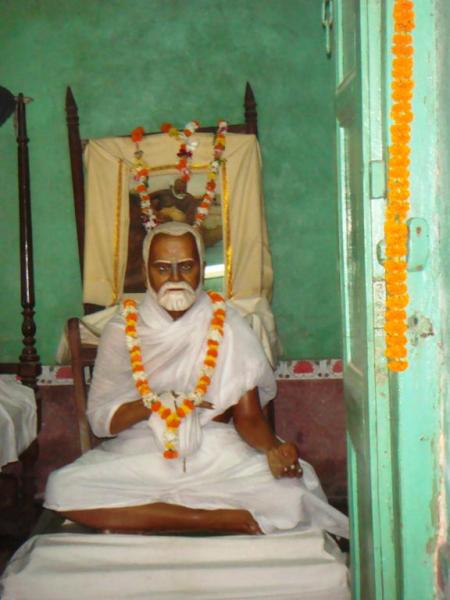
Deity of Srila Jagannatha dasa Babaji Maharaja at his holy samadhi in Navadvipa
[Translated from Srila Narayana Maharaja's Hindi Publication on the Life of the Four Vaisnava Acaryas: Srila Bhaktisiddhanta Prabhupada, Srila Gaura-kisora dasa Babaji Maharaja, Srila Bhaktivinoda Thakura, and Srila Jagannatha dasa Babaji Maharaja]
gauravirbhava-bhumes tvam nirdesta sajjana-priyah
vaisnava-sarvabhauma-sri-jagannathaya te namah
I offer obeisance to Vaisnava Sarvabhauma Sri Jagannatha dasa Babaji Maharaja. He indicated the pastime place of the appearance of Sri Gaurasundara, and he is very dear to the devotees.
Appearance and Introduction
In approximately 1764, Sri Srila Jagannatha dasa Babaji Maharaja appeared in a Sambhrant family in a Mandalakara village within the division of Tangail in the district of Mayaman Simha in present day Bangladesa. Some have the belief that he manifested his appearance pastime in the Tadasa village within the Pavana district of Bangladesa in a Varenda Kayastha family. Up until now we do not have a definite account or acquaintance of his previous asrama’s mother and father, or of the year, date and so forth of his appearance.
Whichever place or whatever family Srila Jagannatha Dasa Babaji Maharaja may have appeared in; in reality he is Bhagavan’s eternally perfected associate and the manifested form (prakasa-vigraha) of Sri Caitanya Mahaprabhu. He is fully realized in the current of the conception of Sri Sri Svarupa-Rupanuga; he is the sarvabhauma (emperor) of the empire of suddha-vaisnavas; he is the eternally worshipable of Srimad Bhaktivinoda Thakura; he is greatly enthusiastic in preaching the message of Godhead; he is the general in the army of nama-sankirtana, and he is a Bhagavat Paramahamsa gosthanandi (one who takes delight in preaching). Sri Vraja and Sri Navadvipa Dhama are his eternal places of residence.
Pancaratriki-Diksa
While staying in his previous asrama, Srila Jagannatha Dasa Babaji Maharaja acted out the pastime of accepting pancaratriki diksa and becoming the diksa disciple of Sri Rasa Bihari Gosvami, a descendent of Sri Nityananda Prabhu, and a resident in the provincial district of Puruliya. That Sri Rasa Bihari Gosvami had one other disciple—Svadhin Tripuradhipati—Svadhamagata Isanacandra Manikya Bahadura. Even today, Sri Rasa Bihari jiu, the worshipable Lordship’s of Sri Rasa Bihari Gosvami, are being served in his royal palace.
Coming to Sri Vraja Mandala
Understanding and seeing the life history of Srila Jagannatha dasa Babaji Maharaja, it is recognized that although he was a topmost devotee of Sri Caitanya Mahaprabhu before coming to Sri Vraja Mandala, still, following the completely pure acara-pracara, out of greed to obtain the devotees transcendental association, he came to Sri Vraja Mandala.
Association with the Visuddha-Rupanuga-Acarya
Out of destiny, Srila Jagannatha dasa Babaji Maharaja came to Sri Vraja Mandala and received the association of the Bhagavata Srila Madhusudan dasa Babaji Maharaja, who was acting out the pastime of being acarya, taking shelter of the method of rupa and rupanuga, and preaching in this way. Obtaining the association of Srila Madhusudan dasa Babaji Maharaja, Srila Jagannatha dasa Babaji Maharaja’s heart, which was burning in enthusiasm for the association of rupanuga vaisnavas, was cooled. From him, Srila Jagannatha dasa Babaji Maharaja received the deep process and tattva of bhajana in the line of the Sri Gaudiya-Vaisnava-sampradaya.
Paramahamsa Vesa
Day and night, Srila Jagannatha dasa Babaji Maharaja began to perform honest service to his Gurudeva, looking after everything. He stayed under the complete guidance of Srila Madhusudana dasa Babaji Maharaja for a long time; residing on the bank of Sri Surya-kunda and showing the perfect example of sadhana bhajana. Seeing his honest service as well as unfathomable love for Sri Gauranga Mahaprabhu, and his desire for the supreme auspiciousness of the residents of the world, Srila Madhusudana dasa Babaji Maharaja gave him paramahamsa-vesa.
A Brief Life History of Srila Jagannatha dasa Babaji Maharaja’s Vesa-guru, Srila Madhusudana dasa Babaji Maharaja
When Srila Madhusudana dasa Babaji Maharaja was only 12 years old, one devotee gave him the sri-harinama-mahamantra along with the 18 syllable sri-krsna-mantra. Although Srila Madhusudana dasa Babaji Maharaja began chanting the mantras at that time, still, in his adulthood he lamented again and again, “How unfortunate I am! I do not know the method of chanting sri-harinama and sri-krsna-mantra! I don’t even know the name of my Gurudeva who gave me the mantra! I never saw him again in my life! I never got the opportunity to serve him, what to speak of receiving any instructions from him. Due to the absence of guru-seva and instructions from him, my human life will pass uselessly. What will be my destination, not knowing the purport of my mantras and guru-parampara?”
Absorbed in these thoughts, he came to Sri Vraja Mandala searching for his Gurudeva. He stayed for some time in Kamyavana, then he traveled throughout many places in Sri Vraja Mandala searching for his Gurudeva; however, not being able to fulfill his desire, he was despondent. Finally, being deprived of the acquaintance of his Gurudeva and knowledge of the process of his mantra, with the intention of taking his life, he tied a very large sila of Giriraja Govardhana around his neck and jumped into Sri Radha Kunda. However, at that time, the supreme ruler of Sri Radha Kunda, Srimati Radhika and Her beloved Sri Krsna lifted him up with Their hands and placed him on the banks of the pond. They wrote on tala leaves the name of his Gurudeva, his guru-parampara, the process of chanting his mantras, as well as many other subjects, and placing them near him, They disappeared. By the causeless mercy of Sri Sri Radha-Krsna he became aware of all these subjects: his Gurudeva was a follower in the line of sri-rupanuga-vaisnava-pravara Srila Baladeva Vidyabhusan Prabhu—Sri Uddhava dasaji, who was engaged in sri-rupanuga-bhajana following the disciplic succession and doctrine of the Sri Brahma-Madhva-Gaudiya-Vaisnavas.
A short time after, Srila Madhusudana dasa Babaji Maharaja began to reside at the supremely pure pastime place on the banks of Surya-kunda, in the kunja named ‘Madana-rana-vatika’ situated five miles north of Sri Radha Kunda. Once, when Srila Babaji Maharaja was sitting in his bhajana-sthali, ‘Madana-rana-vatika,’ the pastimes of holi in Vraja manifested upon the screen of his transcendental vision. While watching, Srila Babaji Maharaja entered into the pastimes with his perfected form. People nearby saw that many different colors were on his clothes as well as an unprecedented fragrance; hearing people murmuring, Srila Babaji Maharaja came back to his external senses. Since this occurrence, Srila Madhusudana dasa Babaji Maharaja is famous in Surya-kunda as ‘Siddha Babaji.’
There is a common saying or rumor that when Srila Madhusudana dasa Babaji Maharaja explained the Srimad-Bhagavata in his bhajana-kutira at Surya-kunda, a python would come daily with a fixed routine and hear his explanations. When they were completed, the python would offer dandavat-pranams and then go away.
Srila Babaji Maharaja bathed in Sri-Surya-kunda every day. One night Srimati Radharani appeared in a dream and told him, “In this kunda there is a Giridhari sila with My crown printed on it. Take this sila out and worship it.” Srila Babaji Maharaja woke and sat up from his dream, and in the morning, being extremely pleased at heart, followed the order of Srimati Radharani, and took the sila out of Surya-kunda. Even though the sila appeared to be approximately 2 to 2 ½ manas or 80-100 kilos, when Srila Babaji Maharaja lifted it, it became lighter then a flower. Since then, Srila Babaji Maharaja worshipped the sila every day.
Up to the present day, the sila worshipped by Srila Madhusudana dasa Babaji Maharaja, as well as the worshipable nama-brahma, or names of Bhagavana such as Sri Hare Krsna’ and ‘Sri Haribol’ written upon wood, are served in a temple on the banks of Sri Surya-kunda. Srila Madhusudana dasa Babaji Maharaja’s samadhi and his ancient worn out bhajana-kutira are also present.
At Surya-kunda, the disappearance day of Srila Madhusudana dasa Babaji Maharaja is followed on agrahayana suklastami.
Sri Gaura Bhakta, Srila Jagannatha dasa Babaji Maharaja
After taking paramahamsa-vesa, Srila Jagannatha dasa Babaji Maharaja wandered in different places within Sri Vraja Mandala and Sri Gauda Mandala for the welfare of the world, increasing the beauty of those places. Babaji Maharaja perceived Sri Gauda Mandala to be non-different from Vraja Mandala. In the same way that all of Sri Krsna’s qualities are showered upon the devotees of Sri Krsna, similarly, all the qualities of Sri Gaurahari such as deep honest taste for chanting sri-nama following—‘trnad api sunicena, tarorapi sahisnu, amanina manadena’ were manifest in Srila Jagannatha dasa Babaji Maharaja. Srila Jagannatha dasa Babaji Maharaja obtained all good qualities and became the most fortunate of the fortunate.
Sri Madhusudana dasa Babaji Maharaja’s Departure
When the time came, by the will of Bhagavan, Sri Madhusudana dasa Babaji Maharaja performed his disappearance pastime. Along with his other godbrothers, Srila Jagannatha dasa Babaji Maharaja placed his Gurudeva in samadhi on the banks of Surya-kunda. Although he spent most of his time at Surya-kunda, still, he would sometimes go to Sridham Navadvipa for some days and then again returned to Surya-kunda.
His Preaching Pastimes as Acarya
For those who renounce everything and take the one-pointed shelter of Sriman Mahaprabhu, taking a vow to preach His message, then Bhagavan Sri Gaursundara accepts his bhajana. By thinking, “I am a low and destitute Vaisnava; however, by making disciples, my so-called humble bhajana, which is actually full of pride, will be destroyed.” Leaving this powerful arrogance of being a great devotee aside, and taking suddha-nama with humility, both showing by one’s own personal example, as well as preaching suddha-nama and taking the responsibility of being guru, then the waves of sense enjoyment in the form of material prestige will be diminished. Srila Rupa, Srila Sanatana, Srila Jiva and Srila Raghunatha dasa, as well as other great pure devotees gave instructions by the method of composing scriptures, while Sriman Narottama, Srila Madhvacarya, Srila Ramanujacarya and others accepted many disciples. Many foolish people became offenders at the lotus feet of the actual akincana devotees by thinking that such preaching activities were obstacles to the limbs of bhakti and were merely waves of sense enjoyment. Following the above-mentioned Vaisnava-acaryas’ magnanimous and lofty moods, Srila Jagannatha dasa Babaji Maharaja followed the instruction of Sri Caitanya Mahaprabhu:
yare dekha, tare kaha ‘krsna’-upadesa
amara ajnaya guru hana tara’ ei desa
Sri Caitanya-caritamrta, Madhya-lila 7.128
[Tell everyone you meet the instructions of Krsna. Under My order become a guru and deliver everyone in this land.]
Thus, when any person would naturally come to Srila Babaji Maharaja, he would immediately begin to deliver visuddha-hari-katha. Seeing the incomparable anuraga of Srila Jagannatha dasa Babaji Maharaja towards Sri Gaurasundara, and the unfathomable enthusiasm towards Sri Caitanya Mahaprabhu’s practice and preaching, many devotees were attracted to the shelter of Srila Babaji Maharaja, and passed their lives with great renunciation in his care, thus making their lives fortunate and successful. Many householders also followed Srila Babaji Maharaja’s instructions.
Strictly Following the Method of Sri Rupanuga-bhajana
Srila Jagannatha dasa Babaji Maharaja’s chastisement was nirapeksa (neutral or indifferent), his strong instructions for the welfare of the soul were poignant. Srila Babaji Maharaja stayed for a long time in the shelter of the banks of Sri Radha-kunda. Following the method of Sri Rupanuga-bhajana, he would perform Sri Radha-Govinda’s eternal service with an attentive mind through the medium of nama-bhajana. Srila Babaji Maharaja stayed in this world for 142 long years, continuously performing sri krsna kirtana and inspiring others to also perform sri harinama. Babaji Maharaja never accepted any siddhanta or conception other than the one and only method of following all other limbs of bhakti through connection with kirtanakhya-bhakti. With mind absorbed intently in moods of separation, he would perform hari kirtana himself, and he gave instruction for others to do the same. He never patronized the pretense of full absorption in nama bhajana with an enjoying mentality, or hypocritically following solitary bhajana. Apart from chanting the 16 name, 32 syllable mahamantra that emanated from Sriman Mahaprabhu’s lotus mouth, he never patronized the nama-aparadhi’s who performed speculative, imaginary modern mantras full of rasabhasa and opposed to siddhanta.
Under the guidance of Srila Jagannatha dasa Babaji Maharaja’s instructions, the followers of Sri Rupanuga never performed any rasabhasa singing or any type of nama-aparadha in the place of ‘suddha nama’ and ‘sri nama kirtan.’ Frivolously performing harinama with sraddha is one thing, but not giving up nama-aparadha, yet rather thinking it to be pure ‘nama’ and protecting or maintaining one of the nama-aparadhas amongst them all with such a foolish conception, thinking, “my sri harinama kirtana is going on nicely”—such patronizing self-deception is another thing completely. Srila Babaji Maharaja never tolerated anything opposed to siddhanta or anything with the fault of rasa-abhasa.
[Translated from Srila Gurudeva’s Hindi Publication on the Life of Srila Jagannatha dasa Babaji Maharaja, by Rasik Mohan dasa]
# 2nd Post

Sunday, December 18, 2016

Chant Hare Krishna to be Saved from the Evils of Kali Yuga

The maha-mantra appears in the Kali-santarana Upanisad of the Krsna Yajur Veda wherein Lord Brahma is answering a question by Narada Muni:
(1)
harih om
dvaparante narado brahmanam jagam katham
bhagavan gam paryatan-kalim santare-yamiti

sa hovaca brahma –
sadhu prsto’smi sarva sruti-rahasyam gopayam
tacchrnu yena kali-samsaram tarisyasi bhagavata
adi-purusasya narayanasya namoccarana-matrena nirdhuta-kalir bhavati
At the end of Dvapara-Yuga, Narada, who had traversed the whole world, went to Brahma and addressed him thus, ‘O Lord, how shall I be able to ward off the effects of Kali?’ Brahma thus replied, ‘You have asked an excellent question. Listen to that secret which all the Vedas keep hidden, through which one may cross over material existence during the age of Kali. One becomes free from the influence of Kali by merely uttering the Names of Lord Narayana, who is the original Supreme Person.
(2)
naradah punah papraccha tananam kimiti
sa hovaca hiranyagarbah –

hare krsna hare krsna krsna krsna hare
hare rama hare rama rama rama hare hare

iti sodasakam namnam
kali-kalmasa-nasanam
natah parataropayah
sarva-vedesu drsyate
Thus again Narada asked Brahma, ‘What are those Names?’
Lord Brahma replied, ‘Hare Krsna Hare Krsna Krsna Krsna Hare Hare, Hare Rama Hare Rama Rama Rama Hare Hare. These sixteen Holy Names will destroy the sinful influences of the age of Kali. I do not see any other method'.

Friday, December 16, 2016

Why Chant Hare Krishna?


from Back to Godhead, May-June 1994

Here’s a page full of reasons. I’ll spare you the footnotes, but each reason is fully upheld by evidence from Vedic writings like Bhagavad-gita, the Upanisads, and the Puranas.
  • Chanting Hare Krishna awakens love of God.
  • Chanting Hare Krishna brings liberation as a side benefit along the way.
  • When you chant Hare Krishna, you automatically develop knowledge and detachment.
  • Chanting Hare Krishna gets you out of the endless cycle of birth and death.
  • It is the most effective means of self-realization in the present Age of Quarrel. Nothing else works nearly as well.
  • Chanting Hare Krishna cleanses the heart of all illusions and misunderstandings.
  • By chanting Hare Krishna, you become free from all anxieties.
  • Chanting Hare Krishna brings you to self-realization—and shows you how to act as a self-realized soul.
  • It keeps you ever mindful of Krishna, the reservoir of pleasure.
  • There are no hard and fast rules for chanting. You can chant anywhere, any time, under any circumstances.
  • Krishna Himself is fully present in the transcendental sound of His name. And the more you chant, the more you realize it.
  • All other Vedic mantras are included in the chanting of Hare Krishna. So just by chanting this mantra, you get the benefit of all others.
  • Chanting Hare Krishna purifies not only you but every living entity around you. Whoever hears the chanting gets spiritual benefit.
  • A person who chants Hare Krishna develops all good qualities.
  • You can chant Hare Krishna softly for personal meditation or loudly with your family or friends. Both ways work.
  • Srila Prabhupada chanted Hare Krishna, and so did great souls in the past. So why not you?
  • It’s free. Chanting Hare Krishna never costs you money.
  • Chanting Hare Krishna brings the highest states of ecstasy.
  • There are no previous qualifications needed for chanting Hare Krishna. Young or old, anyone can chant—from any race, any religion, or any country of the world.
  • Even if you don’t understand the language of the mantra, it works anyway.
  • Chanting Hare Krishna brings relief from all miseries.
  • Chanting Hare Krishna is easy. When the best way is also the easiest, why make life hard for yourself?
  • Chanting Hare Krishna invokes spiritual peace—for you and for those around you.
  • When you chant Hare Krishna, Krishna Himself becomes pleased.
  • When you chant Hare Krishna, Krishna dances on your tongue.
  • By chanting Hare Krishna you can return to Krishna’s world, the eternal abode of full happiness and knowledge.
  • Chanting Hare Krishna frees you from the reactions of all past karma. Chanting Krishna’s name even once, purely and sincerely, can free you from the reactions of more karma than you could possibly incur.
  • Chanting Hare Krishna counteracts the sinful atmosphere of Kali-yuga, the present Age of Hypocrisy and Quarrel.
  • By chanting Hare Krishna you can relish at every step the full nectar that’s the real thirst of the soul.
  • The more you chant Hare Krishna, the better it gets.
  • If you look through all the Vedic scriptures, you’ll find nothing higher than the chanting of Hare Krishna. Hare Krishna, Hare Krishna, Krishna Krishna, Hare Hare/ Hare Rama, Hare Rama, Rama Rama, Hare Hare.